
 |  |  |

Custom Search
Showing posts sorted by relevance for query heron. Sort by date Show all posts
Showing posts sorted by relevance for query heron. Sort by date Show all posts
Tuesday, February 1, 2011
Smart Birds 1


Thursday, January 27, 2011
Headless Heron

Friday, March 19, 2010
Great Blue Heron (Ardea herodias)

| Thanks to a suggestion from a visitor to this site, I went to Cuthbert Holmes Park yesterday where some Great Blue Herons (Ardea herodias) are nesting in a group known as a heronry. Local users of the park helpfully guided me to the best location to view the birds. I saw about a dozen of these large nests while I was there but there are probably more since quite a few are located in living trees and are hard to see because they are hidden by the foliage. In years gone by this heronry has been under attack by Bald Eagles who swoop down on the heron nestlings. While I was there an eagle cruised slowly overhead. Though he was a long ways above, sailing peacefully along, all the herons took flight and began circling around their nesting area and making loud calls. A regular visitor to the park told me that she had to curtail her visits to the park last year because of the heartrending scenes arising from the eagle attacks. |  |
The visitor mentioned above, Mike Laplante, has also blogged some of his photos of these birds with some interesting background information, HERE.
Saturday, July 5, 2008
Thoughtful
 Thoughtful? This is the Great Blue Heron. I describe this bird as thoughtful because of the way he stands perfectly still for long periods of time. Most birds flap into view, perch beguilingly until I have my camera out, then fly off cackling just as I raise it to my eye. Not the Great Blue Heron. This bird strikes a pose and holds it, for five or ten minutes. Other birds please take note. This is proper behavior, thoughtful!
Thursday, February 16, 2012
Cold Old Friend
 Swan Lake Nature Sanctuary is still in winter mode though a few green buds are swelling. When I was out there yesterday there was a chill wind blowing and this Great Blue Heron was tucked up against the cold. I wish I had this Heron's sharp and beady eye this morning because I had intended to post a photo of one of the many other birds I saw there. However, my bird field guides are apparently still unpacked and until they are found....
Friday, May 6, 2011
In-Flight Entertainment

Why Great Blue Heron? When I look at the above photo I see lots of gray, some black and orange, some yellow and white but no blue of any shade. There is also a "Green" Heron which is equally un-green if the photos are anything to go by. One doesn't mind if the Latin names for plants and animals don't communicate much except to ancient Romans, but generally one expects the common names to refer to some distinctive aspect of the plant or animal. Oh well, sometimes life is just plain disappointing. Things don't make sense and there is not even any good reason for the confusion.
Sunday, April 30, 2017
Nailed It!

Thursday, May 29, 2008
Animals


Thursday, September 16, 2010
Morning Fog
 Victoria, like its namesake, is a very civilized, genteel city but it is situated on the edge of the vast forests of the Pacific Northwest and thus shares some of the wildness that lies all around. I have been reminded of this on my morning walks lately, with last week's raccoon and this morning's Great Blue Heron, fishing for his breakfast with the Inner Harbour and the Fairmont Empress Hotel dimly visible in the background.
Wednesday, January 20, 2010
Wigeons
When I was much younger and lived in a rural area I liked to do a little bird watching from time to time. I also did a little when I lived in Africa but of late, living as I now do in an urban environment I have pretty much ignored the birds on the assumption that the most interesting ones were hiding out in distant forests. I have featured some of our more common city birds on this blog: seagulls, pigeons (Rock Doves), crows, Mallard Ducks, the Great Blue Heron, Hooded Mergansers, and recently, a House Finch. But lately my interest in birding was challenged and resuscitated when I found out that there are over 100 species of birds that can be seen in Victoria and its environs. Above (foreground) is a new acquaintance, the Eurasian Wigeon (Anas penelope). He's visiting here from much further north and spending some time with his relatives, the American Wigeons (Anas americana)(in the background above and, more clearly, pictured below). These were photographed in Beacon Hill Park a few days ago.
Saturday, November 14, 2009
Witty's Lagoon IV
 Across the strait are the mountains of the Olympic Peninsula in the USA. On this side this couple shares a landscape of blue and gray with a Great Blue Heron hunting for his supper.
Wednesday, March 19, 2008
Great Blue Heron
A nesting colony of Great Blue Herons is located in Beacon Hill Park, within a few minutes walk from downtown Victoria. The colony has been under attack lately from Bald Eagles who occasionally nest nearby, causing a small controversy amongst locals, some maintaining that the herons should be protected while others say that the eagles and herons are natural enemies and the attacks are simply nature taking its course. However, the herons are a small and at-risk population while the Bald Eagle is thriving - estimated population in BC is 20 to 30 thousand, about a third of the North American total. In any case, it seemed like a rare privilege for a city dweller like myself to be able to approach such a splendid creature so closely and I hope the eagles will find something else to eat.

Friday, October 4, 2013
Downy Woodpecker (Picoides pubescens)
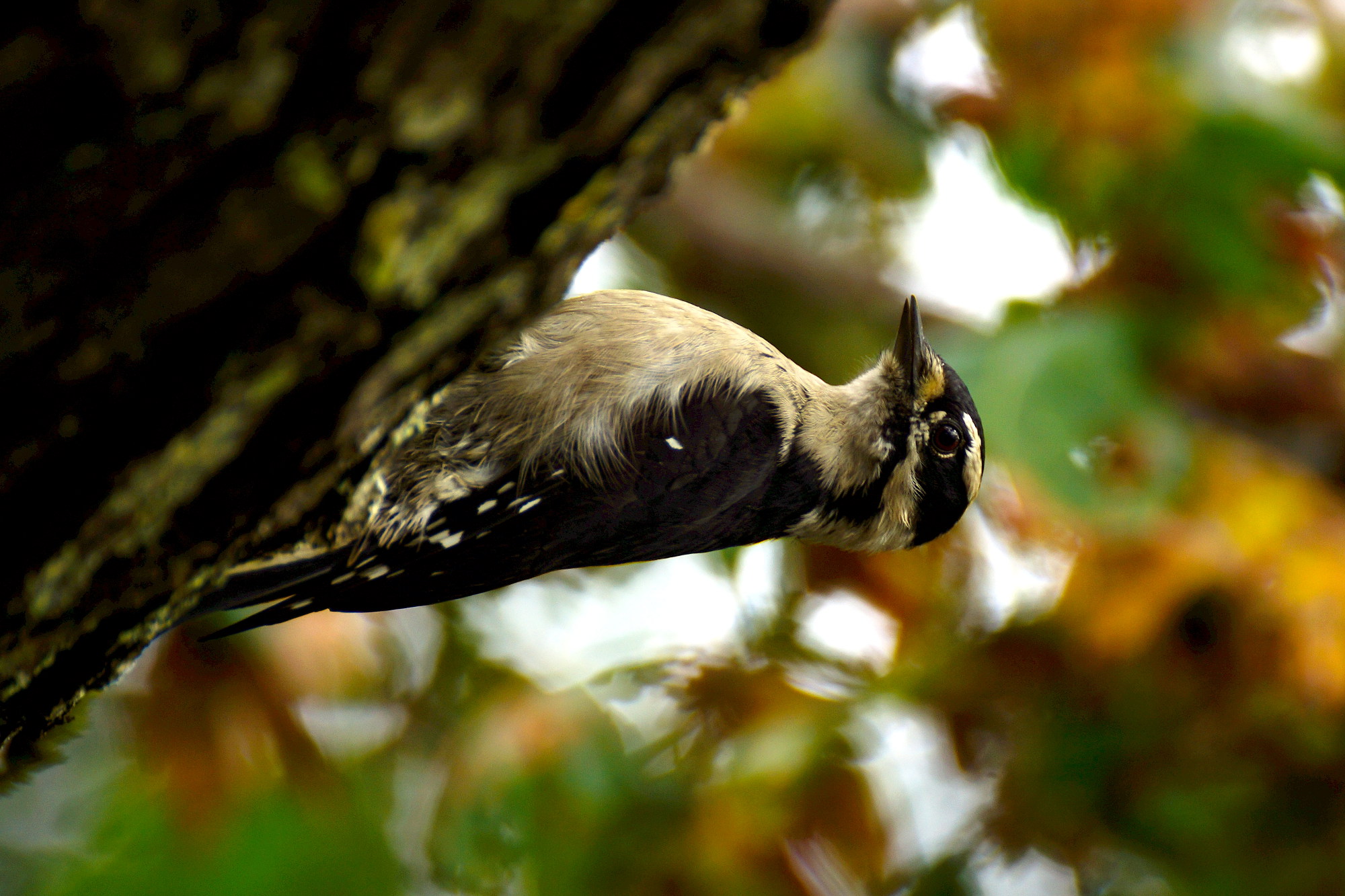
The West Bay Walkway continues to provide an amazing amount of wildlife sightings for an urban environment. This morning on an hour's walk I saw a Harbour Seal, 3 Northern River Otters, 2 Belted Kingfishers, 5 Hooded Mergansers, a Great Blue Heron, small flocks of European Starlings and Robins, a Chestnut-backed Chickadee, as well as a wide variety of joggers and walkers.
Monday, June 6, 2011
Gotcha!


Subscribe to:
Posts (Atom)
